The $100,000 Box of Body Spray: A Cautionary Tale About Hazmat Quantity Limits
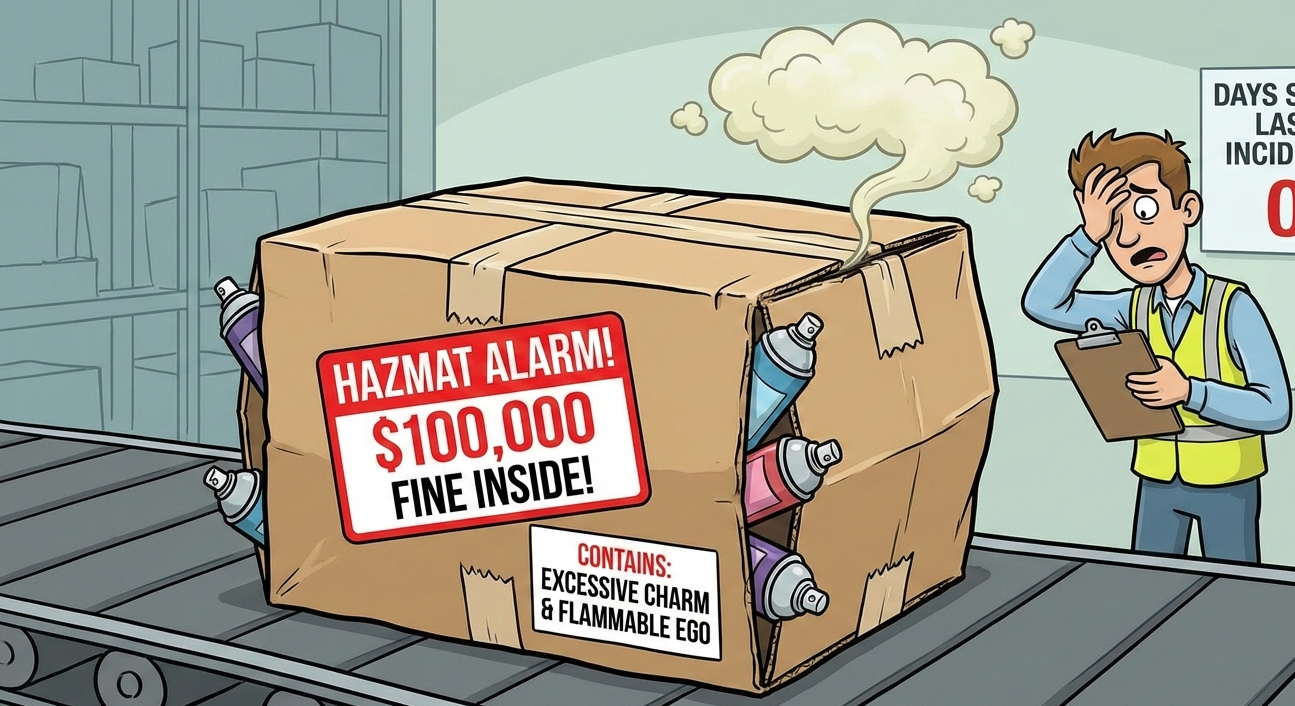
Picture this: You run fulfillment for a mid-sized beauty brand. It’s a Tuesday. Your carrier just rejected forty-seven packages at the facility. There’s a very angry customer in Phoenix, and a compliance officer is using phrases like “civil penalty” and “enforcement action.”
The culprit? Body spray. Specifically, too much body spray in one box.
“But it all fit,” you tell anyone who will listen. “The box wasn’t even heavy.”
This scenario plays out more often than you’d think. And it reveals something that catches a lot of shippers off guard: the rules aren’t just about what can go together—they’re about how much can go together.
The Compatibility Trap
If you ship products containing aerosols, lithium batteries, nail polish, perfume, cleaning supplies, or about a hundred other common e-commerce items, you’re already in the hazmat business. You might even know the basics:
- Aerosols are Class 2.1 (flammable gas)
- Nail polish is Class 3 (flammable liquid)
- Pool chemicals and hairspray definitely don’t go in the same box
That last one is the segregation rule—certain hazard classes can’t be packed together. It’s important. It prevents chemical reactions that range from “mildly exciting” to “explaining things to the fire marshal.”
But segregation is only half the puzzle.
The Limit Nobody Talks About
Here’s where our hypothetical body spray shipment went wrong.
Under 49 CFR (the federal hazmat regulations for ground transport), limited quantity shipments of aerosols have a 30 kilogram gross weight limit per package. That’s roughly 66 pounds, box included.
The packing team had put 24 cans of body spray into a single box. Each can: 200mL, about 250 grams. Total product weight: around 6 kg. Well under 30 kg, right?
Except they forgot to count the box, the packing materials, and—here’s the kicker—the other products in the order. The customer had also ordered a ceramic flat iron (heavy), a salon-size bottle of shampoo (heavier), and a countertop mirror (why).
Total package weight: 34 kg.
Four kilograms over the limit. Forty-seven orders. One very expensive lesson.
And frankly, if 24 cans of body spray had ruptured in transit, the compliance fine would’ve been the second worst outcome. The first would be explaining to a cargo handler why he now smells like a middle school locker room.
The Three Limits You Actually Need to Know
Hazmat quantity regulations work on three levels, and you need to pass all three:
1. Inner Container Limits
This is the maximum amount of hazmat allowed in a single bottle, can, or tube.
For Class 3 flammable liquids (like nail polish) shipped as limited quantity by ground, the inner limit is typically 1 liter per container. Your 15mL nail polish bottles? Fine. A gallon jug of acetone? Not as a limited quantity—that needs fully regulated packaging.
2. Outer Package Limits
This is the total hazmat (or total weight) allowed in one shipping box.
For ground limited quantity, it’s usually 30 kg gross weight. For air shipments, limits vary by hazard class and whether you’re on a passenger or cargo aircraft. Some materials max out at 1 liter total per package for passenger flights.
3. Q-Value (Air Transport Only)
This one’s fun. When you mix different hazardous materials in the same box for air shipment, you need to calculate something called the Q-value:
Q = (quantity₁ ÷ max₁) + (quantity₂ ÷ max₂) + …
If Q exceeds 1.0, your package is non-compliant.
Let’s say you’re shipping 500mL of perfume (max allowed: 1L) and 300mL of nail polish (max allowed: 1L) in the same box:
Q = (0.5 ÷ 1.0) + (0.3 ÷ 1.0) = 0.8 ✓
Add another 400mL of perfume and suddenly:
Q = (0.9 ÷ 1.0) + (0.3 ÷ 1.0) = 1.2 ✗
Now you need two boxes.
The Consequences Spectrum
What happens if you get this wrong? The range is impressive:
Best case: Carrier rejects the package at the facility. You reship. Customer is mildly annoyed. You eat the extra shipping cost.
Medium case: Package gets through but is flagged during an audit. You receive a warning letter that uses the phrase “corrective action” multiple times. Your compliance team develops a twitch.
Exciting case: DOT civil penalty. For hazmat violations, fines start around $500 per violation and can reach $99,756 per violation for willful offenses. Per. Violation. Those forty-seven boxes in our scenario? That’s forty-seven potential violations.
Movie-plot case: Something actually goes wrong in transit. Aerosol cans rupture due to overpacking pressure. Contents interact with other packages. Fire suppression system activates in a cargo aircraft. FAA gets involved. Lawyers get involved. Insurance gets very expensive.
I’m told the movie-plot version is rare. I’m also told the FAA has a whole department that investigates undeclared and improperly packed hazmat shipments, and they are very good at their jobs.
Why This Is Actually Hard
The frustrating thing is that quantity limits aren’t simple lookups. They depend on:
- Hazard class and division (Class 2.1 vs 2.2 vs 2.3)
- Packing group (I, II, or III for most classes)
- Transport mode (ground limits differ from air limits)
- Shipping category (limited quantity vs fully regulated vs excepted quantity)
- Aircraft type (passenger vs cargo-only, for air)
- What else is in the box (for Q-value calculations)
That’s a matrix with hundreds of cells, and the values change when PHMSA or IATA update their regulations (which they do annually).
Most warehouse management systems don’t track this. Most packing stations definitely don’t. The typical process is “does it fit? Ship it.”
How We’re Thinking About This
At Stoa, we’ve been building hazmat intelligence into StoaPack—our 3D bin packing API. The segregation logic shipped earlier this year: pass a UN code, and incompatible materials automatically go into separate packages.
Now we’re adding quantity limits.
The challenge was making it practical. Not every e-commerce system has detailed hazmat data on every SKU. Some know the UN code. Fewer know the exact net quantity per container. Almost none track inner container counts for multi-packs.
So we built a tiered system:
If you give us just the UN code: We estimate quantity from item weight, apply a conservative safety margin (30% buffer), and split packages early rather than risk non-compliance. Not perfectly efficient, but always safe.
If you give us the UN code plus net quantity: We use exact values, enforce actual regulatory limits, and optimize for minimum packages while staying compliant.
The response tells you which mode we used and why, so there’s no mystery about what happened.
The Practical Takeaway
If you’re shipping products that might be hazardous materials (and if you sell beauty, automotive, household chemicals, batteries, or CBD products—you probably are), here’s the minimum you should know:
-
Quantity limits exist. “It fits” and “it’s legal” are different questions.
-
The 30 kg rule is your friend. For ground limited quantity shipments, staying under 30 kg gross weight per package keeps you out of most trouble.
-
Air is stricter. If you’re shipping hazmat by air, the limits drop significantly, and you need to think about Q-values for mixed shipments.
-
Inner containers matter too. A gallon of flammable liquid can’t ship as limited quantity, no matter how big your box is.
-
When in doubt, split the shipment. Two compliant packages are infinitely better than one non-compliant package.
And maybe don’t put 24 cans of body spray in a box with a ceramic flat iron. Even if it fits.
Want to learn more about hazmat shipping compliance? We’re building tools to make this easier. Check out StoaPack or reach out—we like talking about boxes more than is probably healthy.
Disclaimer
This content is for informational purposes only and does not constitute legal, regulatory, or professional compliance advice. Consult qualified professionals and refer to official regulations (49 CFR, IATA DGR, etc.) for compliance requirements.